
Better homes = better communities
Latest NewsBetter homes = better communities
Published: March 26, 2026
Good quality social housing that is safe and affordable is crucial for creating strong, inclusive communities.
It enables families to lead healthy lives and contribute positively to the area where they live.
Registered providers manage over 4.5 million social housing units in the UK and demand for quality social housing continues to grow. As of March last year, there were 1.3 million households on waiting lists. This presents both challenges and opportunities for the sector.*
As a social impact bank, Unity supports organisations that deliver positive impact.
Through our business banking and specialist lending services, we help housing associations to provide good quality social housing to those who need it most.**
Our vision is that all housing associations, irrespective of size, have consistent and equitable access to the expert support and provision they need.
Over the past 10 years alone, Unity has provided over £170 million worth of lending to housing associations. This lending was accompanied by the support of a relationship manager with specialist expertise in this sector.
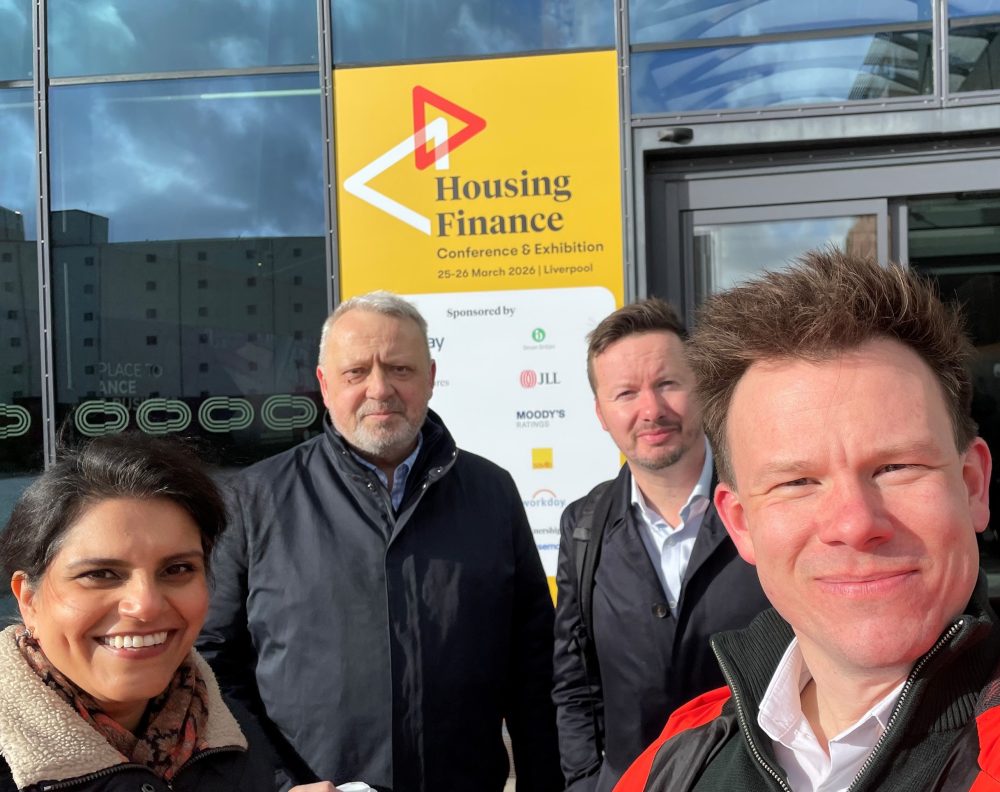
Four of these relationship managers attended the National Housing Federation’s Housing Finance Conference & Exhibition at ACC Liverpool this week.
Paul Wedderspoon, Richard Leighton, Steven Lovell and Sukhie Gakhal talked to a number of customers and prospects.
They explained how Unity can support them through new sustainable housing stock and retrofit activities. Helping to futureproof existing properties and reduce energy bills for tenants.
Challenges and opportunities
In recent years, the regulatory environment for social housing has expanded significantly. Landlords are required to meet higher standards across safety, engagement and governance.
For example:
- Landlords must ensure full compliance with Awaab’s Law. They also need to prepare for its phased extensions in 2026 and 2027 as additional hazards are brought into scope.
- They should plan for the outcome of the Decent Home Standard review and the introduction of the Minimum Energy Efficiency Standards.
- They need to consider how the combined impact of these developments could impact on their business plans.
While reforms are widely supported, they inevitably mean an increase in operating costs.
The UK Government Sector Risk Profile states:
‘As well as risks specific to the sector, landlords are dealing with wider economic challenges. This includes the increased cost of debt. Landlords are exposed to labour cost inflation and continued labour market shortages – particularly in the construction and building safety sectors. And landlords are grappling with a weaker housing market, which is impacting on the surpluses that some landlords can generate through the sale of market homes.
‘Landlords also have a fundamental responsibility to keep existing and future tenants safe. The Grenfell Tower fire and the death of Awaab Ishak show the potentially catastrophic consequences of landlord failure, and the sector must continue to learn from these tragedies’.
How Unity can help
Our ambition is to be the leading lender to small housing associations. We pride ourselves on having a long-term, committed presence in this sector.
We are an important source of long-term capital. Our double bottom line means that we report more than profit. Our success is aligned with their successful decarbonisation and social impact.
Unity’s impact amongst those who need it most is significant. Whether it’s access to finance or the impact that this funding affords in terms of adhering to new regulations or saving on ever-increasing energy bills.
At Unity, we take a tailored approach. We are agile and pragmatic. We provide bespoke lending packages that meet the individual needs of our clients.
These include:
- Interest-only loans to reduce cashflow impact
- Extended commitment terms to provide surety of funding
- Fixed rates to lock in debt service costs
- Preferentially priced lending for environmentally sustainable activities. This supports housing associations in achieving their Net Zero ambitions.
Unity’s lending is aligned to the United Nations’ Sustainable Development Goals (SDGs).
The UK government supports the delivery of the SDGs through various initiatives. These include the implementation of the Passivhaus standard. This aims to reduce energy consumption and improve the quality of homes.
Unity offers support through transactional banking, lending and deposits. We source collaborative solutions for borrowers’ goals to decarbonise and improve their property portfolios. This enhances the safety, health and warmth of their tenants’ homes.
We have a robust understanding of the vital services housing associations provide[KK1] . This is to ensure people can access quality, supportive and affordable accommodation.
We also understand their need for finance to enable retrofitting. This is vital to ensure their housing solutions can continue to be provided.
The journey to Net Zero
We recognise our important role in supporting customers with their journeys to Net Zero.
In 2022, we became the first financial institution to [KK2] [CW3] [KK4] support the award-winning ‘Retrofit Credits’ programme with the Housing Associations’ Charitable Trust (HACT) and Arctica Partners. The ambition is to directly improve the energy efficiency and quality of UK social housing, to contribute to a just transition.
This led to the launch of the tailored loans to help housing association retrofit their properties.
The fee and margin structure is cheaper than Unity’s pricing for all other facilities. The cost is the same regardless of size or scale, allowing smaller operators to access cheaper funds.
The goal is to give borrowers the freedom to allocate budget to their specific requirements in advance, without management of invoices or quotes for each individual drawdown of the facility between the borrower and bank.
Unity funding supported 452 homes in 2023 through its Housing Association Decarbonisation Initiative (HADI).
It was replaced in 2024 by the Retrofit Transition Initiative (RTI) and Unity committed to provide £50 million in funding (up to £3m per customer, alongside a traditional lending product).
A total of 931 homes and two communal spaces were supported in 2024 (129 homes in London and 802 in Scotland).
Whilst the above focuses on Unity’s lending activities for the housing sector, we also provide trusted support for customers.
For example, reviewing the potential climate impact on their properties. This helps assess the potential result of heat and cold stress in advance of any spending. It will help determine whether investments on heating and cooling solutions would be better made in other areas of the portfolio or if a range of investment strategies should be used.
Customer stories
Lincolnshire Employment Accommodation Project (LEAP) received a £1.9 million [KK5] refinance package from Unity in 2025. They used it to provide additional bed spaces for homeless and vulnerable people at its head office.
Heidi Walton is CEO at LEAP. She said: “We’d been with a high street lender since we formed. In recent years we felt they treated us as high risk. They didn’t support us because we’re a charity but we have a more stable income than most businesses.
“When it was time to refinance, we decided to find an alternative lender. Unity was recommended by one of our trustees. When I met relationship manager, Sukhie Gakhal, I knew straightaway Unity was the bank for us. Sukhie could see what we’re trying to achieve and was fully supportive.”
Cambridge Housing Society (CHS) owns more than 3,000 properties in Cambridgeshire and surrounding counties.
It refinanced its portfolio with Unity to the tune of £30 million. This included £3 million through Unity’s RTI initiative.
Jonathan Birkert is Director of Finance at CHA. He said: “There’s an alignment between us and Unity in terms of social value and social impact.
“Our refinancing with Unity had a tight timescale but they kept us up to date throughout. We all worked well together to get this over the line.
“The reduced margin of the RTI loan is obviously beneficial in terms of best value. However, we also like that Unity is very flexible.”
Get in touch
Talk to us about how we can help your housing association. Contact Relationship Manager Paul Wedderspoon at paul.wedderspoon@unity.co.uk
*based on data from the Regulator of Social Housing’s Local Authority data & Statistical data return survey
** Unity Trust Bank offer Business Current and savings Accounts.
For Business Current Accounts Relationship Managers are available for eligible customers only. This includes accounts that have an annual turnover of more than £2,000,000 (Tier 3). Overdrafts are subject to our eligibility criteria. Please refer to our Overdrafts Key Features Document for more information.
Our Savings Accounts, including fixed term, notice accounts and instant access, and are not designed for transactional banking. This means you cannot use them to make payments, or withdraw funds, through Online Banking Please see specific terms and conditions of account for more information.
‘loans offered, Variable: Between £250k and £10m Fixed Rate: Between £250k and £40m (up to a maximum of 120 months), fees are applicable. Lending is subject to status and eligibility criteria. If the security provided is against a property or assets that you own, please remember that these may be repossessed if you do not keep up repayments on your loan please refer to Business Loans | Sustainable Commercial and Property Loans for full information’
(Unity Trust Bank plc is authorised by the Prudential Regulation Authority and regulated by the Financial Conduct Authority and the Prudential Regulation Authority, Unity Trust Bank plc is entered in the Financial Services Register under number 204570. Registered Office: Unity Trust Bank plc, Four Brindleyplace, Birmingham, B1 2JB.Registered in England and Wales number 01713124).