
Our Gender Pay Gap
Working towards a more equal workplace
We’re committed to fairness, transparency and equal opportunity for colleagues. Publishing our gender pay gap data helps us understand where we are today and what we need to do to improve.
What is the gender pay gap?
The gender pay gap shows the difference in average pay between men and women across an organisation. It indicates overall inequality in the labour market, reflecting disparities in career choices, seniority, and working hours (part-time vs. full-time) rather than just unequal pay for the same job.
Any employer with 250 or more employees on 5 April 2025 must report their gender pay gap data to the gender pay gap service by 4 April 2026. As of 5 April 2025, Unity Trust Bank had 253 full pay relevant employees. Of these, 143 were male and 110 were female.
Our gender pay gap
We remain committed to maintaining a diverse and inclusive workplace. In previous years, we’ve adopted a simplified methodology in calculating our gender pay gap, using gross salaries of all employees at a set date.
Now that we’ve surpassed the 250 employees threshold, we’ve aligned our calculation methodology for 2025 as published by the Government’s Women & Equalities Unit. As a result, we report the gender pay gap data shown in the table below.
Our results
Here’s a summary of our gender pay gap for the year up to and including 5 April 2025:
| Year | Mean gender pay gap | Median gender pay gap | Mean gender bonus gap | Median gender bonus gap | CEO pay ratio (target: <20:1) | Proportion of men receiving a bonus | Proportion of women receiving a bonus |
| 2025 | 19.0% | 19.0% | 18.0% | 14.9% | 7:1 | 82.0% | 74.0% |
| 2024 | 2.7% | 17.0% | Data not available* | Data not available* | 8:1 | Data not available* | Data not available* |
*At the date of publishing, 1 April 2026, the new methodology has only been applied to the 2025 figures, 2024 figures are provided under the previous calculation basis.
Definitions
- Mean gender pay gap: The average difference in hourly earnings between men and women across an entire workforce or economy.
- Median gender pay gap: the difference between the median (middle) hourly earnings of men and women, typically expressed as a percentage of men’s earnings.
- Mean gender bonus gap: The difference between the mean bonus paid to relevant male employees to their female counterparts.
- Median gender bonus gap: The difference between the median bonus paid to relevant male employees to their female counterparts.
- Bonus proportions: The proportion of male and female relevant employees who received bonus pay during the relevant period.
For reference, the Bank’s gender source is defined as the mandatory provided information source ‘sex at birth’.
Understanding our gender pay gap
Our colleague profile
On the reporting date of 5 April 2025, 257 relevant employees were employed by Unity Trust Bank. Of this, 253 were classed as full-pay relevant employees. Of the 253 full pay relevant employees, 143 were male and 110 were female.
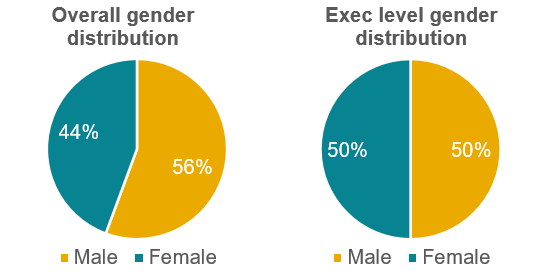
Women held 35% of board positions and 45% of senior roles. At the executive level, representation was evenly split at 50% each. Overall, the workforce was 56% male and 44% female.
Our gender distribution
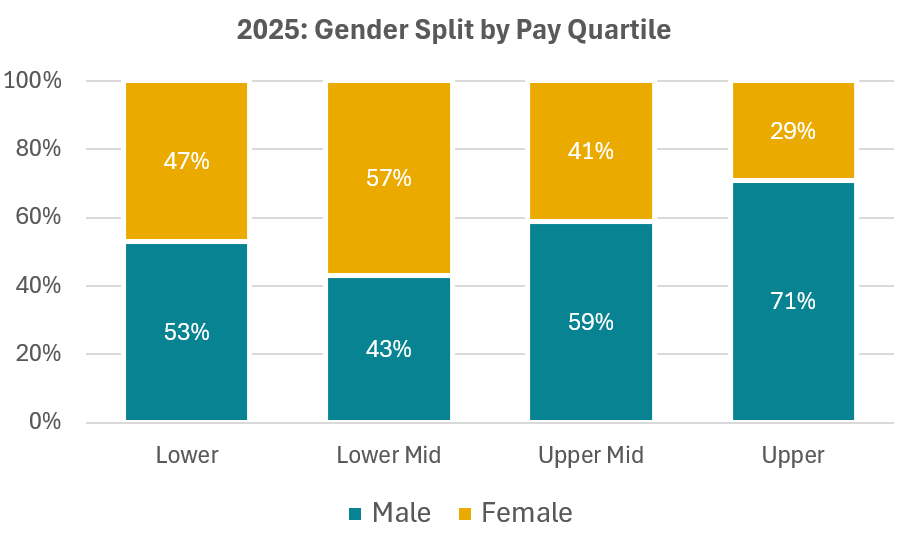
The Bank’s gender balance reflects how men and women are spread across different levels of the organisation.
In 2025, female representation fell across all quartiles. Shifts within the executive team affected this, alongside high recruitment levels in traditionally male‑dominated areas such as technology, commercial leadership, and data.
Explore our gender pay gap report to find out more.
Improving our gender pay gap
We’re taking clear steps to make our workplace fairer, more inclusive and better aligned with the needs of women across the organisation. Our focus includes:
- Introducing a new applicant tracking system and improving our recruitment practices. This includes writing job adverts that appeal more to women, especially those looking for family‑friendly options like hybrid working, flexible hours, part‑time roles or job‑share opportunities.
- Sharing HR data regularly across the Bank so everyone has a clear view of our progress.
- Carrying out regular pay audits to spot and address any pay gaps.
- Implementing a new job evaluation system to help reduce bias, increase transparency and make sure roles match market rates.
- Reviewing our family‑leave policies to encourage equal use and better support all parents.
- Investing in leadership training and development.
- Offering support for colleagues through neuroinclusion initiatives and menopause resources.
- Our Equity, Diversity and Inclusion (EDI) colleague-led forum continues to lead gender‑focused actions and initiatives that support women across the organisation.
- Making the most of our Women in Banking and Finance membership to provide extra guidance and opportunities.
Explore our gender pay gap report to find out more.
Women in Finance Charter: a pledge for gender balance across financial services
The Women in Finance Charter is a commitment by HM Treasury and signatory firms to work together to build a more balanced and fair industry. The Charter reflects the government’s aspiration to see gender balance at all levels across financial services firms.
Unity signed up to the charter in 2020 with 38% female representation at senior management level, and committed to a target of 45-55% gender split in senior management.
As of September 2025, the Bank reported 46% female representation across the whole Bank, with 45% female representation at senior management level and 50% in Executive positions. The Bank’s first female Chair of Board was also appointed in May 2025, taking board female representation to 33%.
Our commitment
We know that closing the gender pay gap takes time and sustained action. We’re committed to making meaningful progress and creating an inclusive workplace where every one can thrive.

At Unity we’ve been on a journey to align how we calculate our data to reflect industry standards giving us a more accurate, consistent and transparent view. As a result, this year’s gender pay gap has increased, but we recognise this is an important step that allows us to track and build on a progress that is fairly reflected in the market.
While this change impacts the headline figure, our commitment to building a diverse, equitable and inclusive workplace remains unchanged. Aligned to our mission and values, we recognise the importance of creating a workplace culture where women can proper, enabling the organisation to thrive as a whole.
We continue to take action towards improving gender balance and increasing female representation at all levels. In 2025 I was extremely proud to see Unity welcome our first ever female Chair, Christine Coe, taking our board female representation to 33% around the same time our Executive team gender balance moved to a 50/50 split of females and males. Our culture is equally important as our gender balance numbers, so inclusivity is something we continue to embed from the ground up at Unity.
 Niki Barker, Chief People Officer, Unity Trust Bank
I confirm that the gender pay gap information in the above report is accurate.
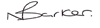
Niki Barker, Chief People Officer, Unity Trust Bank
Making Unity a great place to work
Alongside our work to reduce the gender pay gap, our people‑first culture is reflected in the respected workplace accreditations we’ve earned over multiple years. These include ranking 7th in JP Morgan’s Top 200 Women-Powered UK Businesses 2025 and being awarded two stars for being an ‘Outstanding Employer’ by Best Companies.
These awards recognise our commitment to creating an inclusive, supportive and empowering workplace where our people can thrive and make a meaningful difference.
Supporting our people and communities

Supporting Gender Equality
Working at Unity